Hello everyone! I've created a Symbaloo collection of links which highlight nonfiction in some manner.You'll find links to suggested authors that are great for a study of nonfiction author's craft. Also, you will find links to kid-friendly websites and blogs that give instructional ideas for teachers. You just need to simply click on the picture to start your exploration! :)
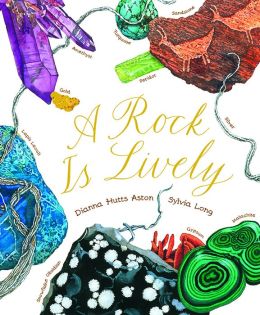
A Rock is Livelyis the newest nonfiction offering from the author and illustrator
duo of Dianna Hutts Aston and Sylvia Long (Chronicle Books, 2012). Their book titles always present an
object from nature with an unusual adjective. The creative title makes a reader curious about why such a title was chosen to go with that topic.
With
this book, the author describes a rock as “lively.” Most students would not
think to describe a rock in this manner because it is not living and obviously doesn't move by itself. :) However, once students journey into the book, the author’s
purpose for calling a rock lively is made clear. Aston describes how rocks
can explode from volcanoes and change over time in many ways in the Earth’s
crust. Aston and Lang’s nonfiction books are written in a conversational
narrative format, and this technique always breathes fresh air into an
otherwise common science topic.
The writing trait of word choice can be exemplified through not only the text, but the unusual statement that serves as the title. Rocks are not thought of as living, independently moving things full of life, and this unique beginning grabs a reader's curiosity. The teacher should ask the students why they think that the author chose to write this specific title with the combination of word chosen for impact. If children are
independent enough, they could record their predictions and wonderings on paper
or in a writer’s notebook. Then, as the teacher reads aloud, children would be
asked to periodically update their reasons and support their new thinking with
evidence from the text. At the end, children would verbally explain or jot
their final summation of why the author chose the title. Children could also
write interesting facts that they learned about rocks down in their writer's notebook
or they could help jot the facts after a discussion on a class graphic
organizer or Thinking Map. A K-W-L chart could be one type of graphic organizer
that could be used for this purpose.
There are specific labels of various rocks represented
in the book, which makes it an example of labeling as an important nonfiction
text feature. A document camera could be used in order to enlarge illustrations
and text features which would help to bring attention to the detail and impact
of the pictures. This book can be a fabulous source of inspiration for
nonfiction writers creating their own research project on rocks or other relevant
science topic. The writing traits of sentence fluency and word choice are
also exemplified with Aston’s writing style. Also, the writing traits of a
distinctive presentation and fluid organization could also be highlighted with
this book in partnership with other Aston/Long titles. Companion Book Suggestions:
There are three previous titles from the author/illustrator duo of Aston and Lang. They would make for a great author/illustrator study!
An Egg is Quiet(Chronicle, 2006)
A Seed is Sleepy (Chronicle, 2007)
A Butterfly is Patient (Chronicle, 2011)
A full listing of books written by Dianna Hutts Aston is available on her author website. Also, a full list of books illustrated by Sylvia Long is available on her own website, too. Chronicle Books has posted a large sample of the text for A Butterfly is Patient. You can review the 13 page sample straight from the computer for educational or home use. Click here to go directly to the Chronicle Books Scribd site. You can also explore an large online preview of A Seed is Sleepy through Google Books.
Lesson Idea: A Rock is Lively can be used as a mentor text for a writing lesson that highlights the trait of ideas. After an interactive read aloud of the story, go on a trek outdoors for a specimen from nature that a child can use for a creative scientific investigation. The object could be a rock or it could be something new like a flower, leaf, twig, or anything that is okay to take inside for observation. If you had access to a collection of rock samples at school and wanted to tie in a study on rocks and minerals, you could definitely take the lesson to an interdisciplinary level that way! Magnifying glasses can even be use to emphasize how the children are figuratively "zooming in" on their topic.
Students would then either use the brainstorming and partner feedback to create a poem or a paragraph where they carefully and creatively selected their words. This would support the application of the trait of word choice because students would think of unusual ways to describe the item. The writing piece that children create after brainstorming about the object could also be shared in a way where other students would have to guess what the object is. Published pieces could be written or typed up with fabulously scientific diagrams. The item could be displayed with the publishing in a class or hallway museum. The options are endless with what direction you choose to take with the lesson!
Here is a two page freebie document that can be downloaded through Google Docs by clicking here. I've left the mentor text area blank so it can be used for other texts as well. Model the use of this sheet and discussions with a student or a another teacher. It fosters an interactive classroom community and gives students an authentic audience that will inspire them to give this a try. Have fun with it and be creative with your word choice! :)
Interrupting Chicken Written and Illustrated by David Ezra Stein Candlewick Press, 2010
Caldecott Honor 2011
Characters who like to read and write
Writer's craft
Humor
Infusion of traditional stories within a storyline (complimentary to fractured fairy tales)
Effective use of dialogue
Writing traits:
voice
presentation
Bonus link:
You can check out the most recent Caldecott listing from the official site hosted by the Association for Library Service to Children.
Be sure to check out the video from Candlewick about author David Ezra Stein. He explains his writing and creative process for the book. It's a great extension after sharing the story with students.
I wanted to share about a wonderful experience that I recently had at a professional conference. The conference was the second annual Joy of Children's Literature and Literacy at the College of William and Mary. This wonderful event was coordinated by Dr. Denise Johnson of William and Mary's School of Education. She is a professor of Reading, Language, and Literacy. Dr. Johnson invited me to introduce author Lester Laminack who was the conference's keynote speaker. I was honored to have this opportunity! Here is the majority of the introduction that I gave for Mr. Laminack:
It is our great fortune to hear
Lester Laminack speak to us today for the keynote presentation entitled “Let
Common Sense Be Our Guide: I Have a Dream for America’s Schools.”Lester is a renowned expert on reading and writing instruction. He is a
Professor Emeritus at Western Carolina University. Lester taught courses in
writing workshop, reading, and children's literature. He is a frequent
presenter across the country.
Lester is an author of well-respected
professional texts, articles, and children’s books. Lester served as the
co-editor of Primary Voices for three
years, as well as the editor of the children’s book reviews for the publication
Language Arts from 2003-2006.
Crafting children's books is one of Lester’s many talents. They are favorites
with teachers for reading and writing mini-lessons. They are published by
Peachtree Publishers and include titles such as :
Among its many accolades, Three Hens and a Peacock was awarded the Children's Book Council Award for Kindergarten to 2nd grade Book of the Year in May 2012. (You can learn more about the Children's Book Council Book of the Year Award Gala through this YouTube link.)
Not only is Mr. Laminack an accomplished author of children’s
books, but he is a skilled writer of professional texts as well. One of the professional
titles Mr. Laminack has written and collaborated on isThe
Writing Workshop: Working Through the Hard Parts (And They're All Hard Parts) This was written in collaboration
with Katie Wood Ray and published by NCTE in 2001.
·This year, Lester also co-wrote with Reba Wadsworth The Classroom Library Book
for the Classroom Library Company. You can view a sample of the text
through the Classroom Library’s app for the iPad and iPhone.
Lester is not only an author, he is what I
would consider to be a “teacher’s teacher.” He passionately promotes collaboration among
educators in order to promote the development of great ideas for teaching. He
advocates for educators and respects their vast knowledge and skills as
professionals.
He is steadfast in his beliefs that reading
aloud to children is powerful and life changing, and that it is critical to the
growth and development of children into skillful students. Lester highly
promotes the use of great picture books for instruction as this fosters the
idea of providing real mentors for children.
He talks with students as if they are fellow authors standing side by
side in the journey of composing writing.
Lester is a master of reaching the reader and pulling them right into
his books.
Lester believes
in something that I tell children I work with in writing workshops: “You make
the ordinary extraordinary just by writing it down.” Every day events and
memories hold importance and they are worthy of capturing in writing. He promotes the notion that in order to be a great
writer, you must be a ravenous reader. As a
presenter and author, he mentors fellow educators and children alike. Whether
you have had the great fortune of hearing Lester speak before or if this is your first time, you will
undoubtedly find what he has to say to be compelling. Lester is genuine in his
compassion for others and respects every adult and child for what makes them
unique as a person.
I highly recommend that if you need your “teacher
soul” to be encouraged and renewed, reread your favorite Lester Laminack
professional books. I particularly recommend that you read his closing essays
which he wrote in his Scholastic professional titles. You will never tire of his messages and how
he encourages you as a teacher. He will
passionately remind us all that school is about more than test scores and
accountability. Lester stokes our fire
within to educate and nurture the future.
If you have ever had the great fortune of hearing Lester speak in person, you are well aware of how captivating he is. He can touch your heart as you connect to his loving memories of his grandmother as he discusses his inspiration for Saturdays and Teacakes.Lester can invigorate your sense of advocacy as he shares stories that served as motivation for Bullying Hurts. His sense of humor and comedic timing engages you and gives you laughter that warms your soul. Something that Lester shared with the crowd at the conference was the notion that we read because it matters, and that you must instill in your students the sense of how will they be altered after reading a powerful story. Lester also encouraged us all to keep asking those in-depth questions which activate critical thinking skills. He also shared that when you share a book aloud with your students, that you are "no longer standing on the banks of the story, you jump into the current." He ended his session with a wonderful piece he originally wrote in 2008 called, "Toward a New Vision for Our Children and Their Schools: I Have a Dream." You can read this speech in its entirety via the Classroom Library Company website. What to learn more about Lester's works? You can enjoy listening to Lester read aloud from Saturdays and Teacakes from this link from Scholastic. Also, be sure to click on the titles of the picture books and professional titles to learn more about the books and to read samples of the texts. If you are interested in the app which shows a sample of Lester and Reba's Book The Classroom Library Book, you can download the app for 99 cents through the App Store and read the first 19 pages of the book through the home screen. The full book is available through the company online.
Here are some wonderful links to go explore to learn more about Dr. Denise Johnson's work I am so fortunate that I have not only experienced her as an amazing professor, but I also consider her a dear professional friend. :)
She has authored numerous professional articles, chapters, and books. To find out more about her 2nd edition of the textbook, The Joy of Children's Literature, you can click the picture below to find out more about it.
In my next post, I will share about a mentor text lesson where I recently used one of Lester Laminack's books in a Lit. Coaching lesson with a class. :) Please stay tuned!
I really enjoy the annual showcase of August 10 for 10 Picture Books from a wide variety of fellow bloggers! This event is virtually co-hosted on the Internet by bloggers Cathy Mere and Mandy Robek. Mandy's blog is called Enjoy and Embrace Learning, and Cathy's blog is called Reflect and Refine: Building a Learning Community. Three years ago, they started this event and shared their recommendations for picture books that you can't live without via the Blogosphere and fellow Twitter users. I posted for the August 10 for 10 for the first time last year, and I gave my post a focus of ten great picture books that had come out within the past year. This year, I decided to highlight nature-inspired picture books that had come out in the past twelve months. I adore both fiction and nonfiction texts which have nature woven within the story. Like so many other topics, I love that an appreciation for nature can be supported through the talent of finely tuned words from a crafty writer and the gorgeous illustrations from a creative artist. As you can imagine, picking just ten books is a challenge. :) Here are ten of some of my favorite nature-inspired picture books from the past year:
1.In the Sea Written by David Elliott and Illustrated by Holly Meade (Candlewick, February 2012)
This book is part of a collaborative series of animal-inspired text by David Elliott and illustrator Holly Meade. They have authored several other books together, includingIn the Wild(Candlewick, 2010) and On the Farm (Candlewick, 2008). The book In the Sea is written about various animals of the ocean habitat through short poems. The illustrations are created through wood block cut prints and create a bold visual. Reading all three of these selections are a distinct style of writing. This collection can also be used to illustrate the writing traits of voice and presentation.
2.The Beetle Book Written and Illustrated by Steve Jenkins (Houghton Mifflin Books for Children, 2012)
I have blogged on several occasions about my appreciation of author and illustrator Steve Jenkins. I enjoy his works so much because of his talent to write about nonfiction in an engaging manner. Like his other books, there is nothing dry or stiff about how he imparts knowledge on these six legged creatures. Here is an excerpt: "The mottled tortoise beetle uses its oversize wing casings like a turtle's shell, tucking its head and legs underneath when danger threatens."
This book can be used in a variety of ways for teaching. The sample sentence given above shows how Jenkins is quite talented with his uses of comparisons and analogies in order to help the young reader visualize a specific breed that they are most likely not familiar with. The text lends itself well to teaching examples of the writing trait of word choice, with the use of words like "threatens," "casings," and "tucking." You can also use the book to highlight how to have an effective lead in writing. He opens up his book with this powerful idea: "Line up every kind of plant and animal on Earth, and one of every four will be a beetle." That opening is effective in illustrating the impact beetles have in our lives, whether we realize it or not! :)
3. Outside Your Window: A First Book of Nature Written by Nicola Davies and Illustrated by Mark Hearld (Candlewick, 2012) Nicola Davies is a noted author of numerous highly appealing nonfiction trade books, including Bat Loves the Night (Candlewick, 2001) and One Tiny Turtle (Candlewick, 2005) You can read more about her work one of my previous posts. In this offering, Davies provides a collection of nature-inspired poetry that will perk the interests of any creature-loving child. The poems are presented by grouping them with appropriate seasons.
This book would be wonderful as an example of a hybrid nonfiction text (a text that is nonfiction, but in a format that is not cut and dry.) Also, the traits of word choice and presentation could be nicely supported with this picture book. Being able to write about nature and observations through poetry certainly exemplifies how to carefully select choice words to support written expression. I would also recommend using this book as a mentor text for "making the ordinary extraordinary" and "exploding a moment." Davies would make for a fantastic and engaging author study as well! Here is the link to Nicola's blog and her website for you to further explore her work. Also, here's a bonus clip that you can share with students straight from Nicola Davies herself. She shares about the magic of discovery and exploring!
4.
Secrets of the GardenWritten by Katherine Weinder Zoehfield and Illustrated by Priscilla Lamont (Knopf Books for Young Readers, 2012)
This book by Zoehfield layers information in an engaging way! There are aspects such as speech bubbles and very scientifically speaking chickens which give more facts beyond the central story line. It lends itself to be read more than one time, once as a story and again as an informational reference. It is fantastic to use with studies of food chains, life cycles, and school garden habitats.
Be sure to check out the Google books preview of the text. You can visit Katherine Weinder Zoehfield's Amazon.com author page here to see the more than 60 books that she has authored. I bet you will find some familiar favorites here! Also, you can explore the official website for Priscilla Lamont here. 5. Over and Under the Snow Written by Kate Messner and Illustrated by Chris Salas Neal (Chronicle Books, October 2011)
Messner's book Over and Under the Snow shares "a secret kingdom under the snow" with readers. The book starts out as a wondering of a child as her and her father go skiing in the snow. This
book can be used as a text which provides an example of comparing and
contrasting things in a story. Children can easily think of what visibly
happens above the ground when winter and snows arrive, but this book
opens children's minds to what happens in what scientists call the "subnivean zone" underground.
This text is the winner of the Golden Kite Award from the Society of Children's Book Writers and Illustrators (SCBWI.) You can read their interview with Kate Messner on the official SCBWI blog here. She shares how she brainstormed about this book on the back of an attendance sheet while on a bus going home from a field trip with her 7th graders when she was a teacher. That is the perfect kind of antidote to share with budding young authors about how seed ideas are everywhere, just waiting to be cultivated and grow! You can follow Kate Messner is a variety of ways online. She can be found on Twitter, Facebook, email, or snail mail. Messner also Skypes with groups and schools, and maintains a page on her website where she gives information on authors who will Skype for free to schools and classrooms! How wonderful is that? She keeps a current blog as an author where you can find out more about her thoughts and work. Be sure to check out her advice for writing on her website as well. It is wonderful to share with students when investigating of her author's craft skills. 6. Creep and Flutter: The Secret World of Insects and SpidersWritten and Illustrated by: Jim Arnoksky (Sterling Children's Books, 2012) Author and illustrator Jim Arnosky has been a prolific author and illustrator of books about nature for many years. This book is fourth in a series for Sterling Children's Books, and there are over 200 spiders and insects featured throughout the book. The books in this series are in a larger format and have fold out page spreads. Previous books in the series include: Thunderbirds: Nature's Flying Predators (Sterling, 2011), Slither and Crawl: Eye to Eye with Reptiles (Sterling, 2009) and Wild Tracks: A Guide to Nature's Footprints (Sterling, 2008). These larger, highly appealing illustrators are great gateway books into Arnosky's collection as an author. He has a variety of books, most of which appear as if you are looking directly in his sketchbook. Arnosky makes for a great author study to review the traits of presentation, organization, and voice in nonfiction writing.
If you haven't explored Jim Arnosky's Crinkleroot books, check out the website devoted just to this character and his nature adventures. Arnosky's cleverly drawn books are a feast for any young naturalist!
7. Nasty Bugs Poems Selected by Lee Bennett Hopkins and Illustrated by Will Terry (Dial, 2012)
In this latest collection of poems, Lee Bennett Hopkins showcases the sometimes yucky (but always intriguing) world of creepy crawly bugs. There are 16 poems from authors such as J. Patrick Lewis, Douglas Florian, and Marilyn Singer.
Lee Bennett Hopkins keeps a blog and a wonderful, comprehensive website that will show you to more of his fabulous compilations. You can read more about Lee Bennett Hopkins in a previous post from my blog as well. In that post, I highlight his work with poetry and how you can explore his work with your students.
Here is a sampling of a poem Hopkins penned himself entitled, "Ode to a Dead Mosquito":
8. Sounds of the Wild: Forest Written and Illustrated by: Maurice Pledger (Silver Dolphin Books, 2012)
This book is an installment in a series by Maurice Pledger. He is a renowned nature artist who does extraordinarily realistic drawings. The series includes titles on other topics such as birds, the jungle, nighttime, bugs, and the ocean. This book on various forest habitats is extra special because it is a wonderful pop up book that includes animal sound effects! That makes this book appealing even to the most reluctant reader. There are five different types of forest habitats showcased in full panoramic spreads throughout Europe and North America.
Author and illustrator Molly Bang, in partnership with friend-scientist Penny Chisholm, created a vibrantly illustrated picture book. This book can be shared as a companion text to Living Sunlight: How Plants Bring the Earth to Life (Blue Sky Press, 2009). Since Chisholm's scientific passion is studying phytoplankton, that gave this book its niche topic. Bang shares on her website that this book took about a year and a half to complete and they made 134 drafts of the book! I think sharing such struggles with students shows them that determination with revision is worth the effort because everyone needs to polish their first attempts. Check out the starred review of Ocean Sunlight on Publishers Weekly and a fantastic interview with Bang and Chisholm which was featured on the Horn Book website in July.
10. Gem Written and Illustrated by Holly Hobbie (Little, Brown Books for Young Readers, 2012)
Holly Hobbie is well known for her Holly Hobbie artwork, as well as the seven book collection of Toot and Puddle picture books. With the book Gem, Hobbie introduces the main idea of the book on the book cover preview: "Look carefully. There may be a gem in your garden." From the inside flap, Hobbie discloses how she found the inspiration for this idea and concept. She wondered about the journey a frog had to take in the spring time. That is a great example to illustrate the trait of ideas and how to zoom in on a topic.
I hope that you have discovered a few books that have peeked your interest! :) I look forward to delving into the other blogs that have also participated in this annual blog round-up. Currently, there are over 60 other bloggers who have posted lists as well! You can follow people that are sharing about August 10 for 10 by searching Twitter with the hash tag #pb10for10. You can also find Mandy and Cathy's compiled collection of August 10 for 10 on their Jog the Web collection for 2012. Bookmark this Jog the Web list to quickly refer to the over 60 blogs that have generously shared their book recommendations to help rejuvenate your use of children's trade book literature. Enjoy the 2012-13 school year everyone! Here's to a wonderful, inspired start to your year!