Pages

Showing posts with label Book Recommendations. Show all posts

Sunday, August 10, 2014

The Annual August 10 for 10 Picture Book Event

    For this year's August 10 for 10 Picture Book blogging event, I have decided to highlight some of my favorite picture books about readers and writers. Any of these books help to build the community of readers and writers with students at the beginning of a new school year. :) Be sure to check out fellow bloggers at the Jog the Web August 2014 10 for 10 bookmark collection to read about other great book suggestions! 


     The Fantastic Flying Books of Mr. Morris Lessmore is a cinematic picture book written and illustrated by William Joyce. At some points, the texts and illustrations actually incorporate a great sense of motion. The story starts out tranquil but quickly changes to a chaotic and surprising wind storm that carries Mr. Lessmore off to a strange new place. He wanders   to find a library and he goes in to explore it. Morris becomes the caretaker of these books and shares them with others. He also works on writing his own book, which he leaves as a legacy of his own life in the end of the book.  


     The Quiet Place is the newest husband/wife collaboration from Sarah Stewart and David Small. In this story, the main character Isabel models a character who writes. The story actually begins and ends within the illustrations on the end pages. Isabel and her family emigrate from Mexico during the 1950s, and the reader learns about how she adjusts to her new American life. The story is told within the format of letters that Isabel pens to her Aunt Lupita left behind in Mexico. The title of the book comes from the quiet place that Isabel’s Papa and brother create which acts as a protective cocoon to read and write. 


     Bear Has a Story to Tell is written by Phillip C. Stead. At the beginning of the story, the Bear is starting to get sleepy with the onset of winter and subsequent hibernation time. Bear feels a need to tell a story and looks for a willing audience. At first, he tries a mouse who is too busy collecting seeds for winter. Then, he asks a duck which apologetically declines because he has to fly south for the winter. The third attempt Bear tries is with a frog, but the frog has to find a warm place to sleep. He checks on the burrowed mole, who is already asleep. Winter snowflakes start to fall and Bear succumbs to hibernating. When spring arrives, he is excited to finally tell his story and gathers all his friends. When he goes to speak, he realizes that he has forgotten the story. His animal friends try to help him remember the story and as a storytelling team, Bear leads them off to tell his tale at the end of the book.


     The Best Story by Eileen Spinelli focuses on a young girl who has her writing interests peeked by a writing contest advertised at the local library. The winner would be able to go on a roller coaster ride with an author that she really likes, so she takes her motivation home with her to start a story. Her brother Tim advises her that good stories have a lot of action, so the girl begins to write over the top exaggerations of action scenes. Then, her father explained that good stories are full of humor. The daughter goes back to her story to inject it full of elements that she thinks are funny. Next, her aunt advises her that the best stories make the reader cry, so the young girl goes back to her story to add twists and turns in the story to hopefully make the reader weep. Her teenage cousin named Anika weighs in with her opinion and says that the book will lose if it is not romantic.
     Once she shares the drafted story with her entire family, the respective family members say that she should add even more of the elements that they championed for. The only person that gives sensible advice is her mother. She says, “I think the best story is one that comes from the heart. Your own heart.” The little girl goes back to the drawing board and completely rewrites her   story so that it isn’t full of unrelated, ridiculous ideas and ends up with a final draft that is much more down to Earth. She ends up writing what she personally knows about and is proud to turn in her submission to the contest.  


     Author/Illustrator Melanie Watt ingenious sense of humor shines in Have I Got a Book for You! The story is about a book salesman named Mr. Al Foxword. He is a stereotypical version of a heavily persuasive pitchman who pulls out all the stops to try to sell you a book as the reader. Mr. Foxword shows you testimonies from satisfied customers, explains how it “is your lucky day,” overly compliments you, and makes you an offer that you can’t refuse. At the end of the book, he realizes that he might be wasting his time trying to convince you as the reader to buy into his ploy, so he leaves you with the parting observation that the last page is “ripped,” so “you break it, you buy it!” 


     Interrupting Chicken by David Ezra Stein won a Caldecott Honor Award in 2011. It is a humorous story about a little red chicken who loves to hear stories from his Papa each night. Unfortunately, the young bird also has an irresistible urge to blurt out and interrupt his father while he is reading aloud. The little red chicken knows how the classic stories end and just wants to jump to the chase. Papa asks the little red chicken to not get so involved in the story because he should be easing into sleep instead.
     Opening segments for Hansel and Gretel, Little Red Riding Hood, and Chicken Little are all interrupted during the course of the story. Papa surrenders for the night, tired and ready to go to sleep. He asks the little red chicken to tell a story instead. A full page spread shows the little red chicken’s writing notebook with a story entitled, “Bedtime for Papa.” In the end, it is the little red chicken who puts Papa asleep with his own bedtime story.
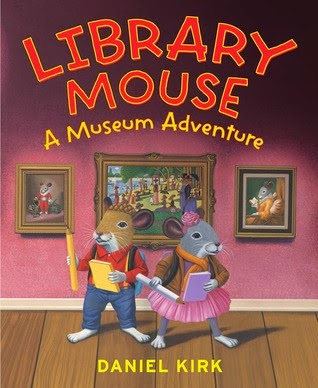


      Library Mouse: A Museum Adventure is the fourth installment in the Library Mouse series by Daniel Kirk. The story opens with Sarah discovering that Sam is busy working on filling his journals with ideas. She suggests that they go explore a museum. This is Sam’s first adventure out of the library that he calls home. Sam convinces Sarah to take along an “explorer’s journal” despite her reluctance.  Daniel Kirk includes art throughout the book that is based on famous works of art from around the world. While on their adventure, a museum guard introduces them to the resident cat artist. Despite initially being petrified by the feline, they end up posing for the artist so he can sketch them. When the artist signed an autograph and note for Sarah in her journal, it spurs her to become interested in her notebook. 
                                                    
    
    Open This Little Book is written by Jesse Klausmeier and it is cleverly engineered with a unique format with illustrations by Suzy Lee. As the title suggests, the reader opens the book to find what appears to be a smaller book within the larger book, and the story continues to unfold through smaller and smaller "books." Each book is referred to as a color, such as the red book or the green book. A different animal is shown reading each book and they interact with one another as the journey builds with each page flip. The color edges of each incremental size of the books creates boxes of rainbow colors when you read the center of the book. The book ends with an idyllic illustration full of reading animals and children. 


     In Rocket Writes a Story, Tad Hills brings Rocket the dog back in the sequel to How Rocket Learned to Read. This New York Times bestseller is about a dog whose companion is a little yellow bird that acts as his teacher. The bird encourages him to collect words on a tree, gather ideas that inspire him, and write his first story.  Rocket reads his story to a pine tree who enjoys his writing. He experiences the value of sharing a story with an audience. 


In Abby Hanlon's Ralph Tells a Story, a classroom of young students have a teacher that passionately declares that, "Stories are everywhere!" However, the main character, Ralph, struggles with writing and he is paralyzed with writer's block. He finds many ways to try to waste time, and then he pleads for help form a fellow student named Daisy. She is so enthusiastic about writing that she tells Ralph that she has written many stories about him doing everyday events. After further struggle, Ralph winds up under his desk imagining a scene with an inchworm. His teacher encourages his daydreaming in hope of helping him find a writer's spark. Ralph eventually shares one written sentence about an inchworm and verbally elaborates on the story at share time. Everyone in the class was thrilled to hear Ralph's author's voice. 


Saturday, April 26, 2014

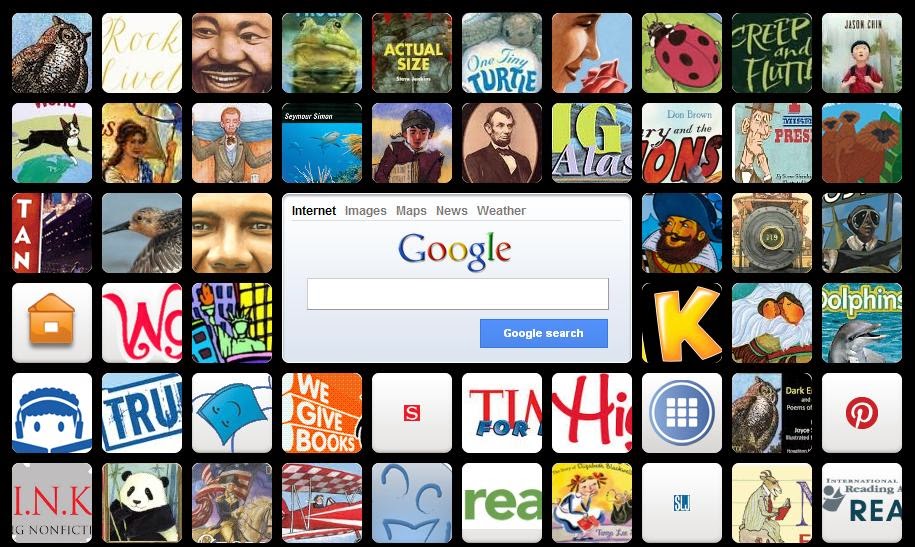
Symbaloo Collection of Nonfiction Links


    Hello everyone! I've created a Symbaloo collection of links which highlight nonfiction in some manner.You'll find links to suggested authors that are great for a study of nonfiction author's craft. Also, you will find links to kid-friendly websites and blogs that give instructional ideas for teachers. You just need to simply click on the picture to start your exploration! :)

http://www.symbaloo.com/mix/nonfiction2
 

Tuesday, April 8, 2014

Featured on the Nerdy Book Club Blog: Little Red Writing - Written by Joan Holub and Illustrated by Melissa Sweet

   Hi everyone! If you aren't familiar with the Nerdy Book Club blog, it's definitely worth checking out! The Nerdy Book Club is a blog community of readers who read children's and YA literature. The blog welcomes readers to write posts for the blog as well. To find out more, click here to explore the options and fill out their online application. You can keep up with the daily posts on the Nerdy Book Club blog via Facebook as well.


http://nerdybookclub.wordpress.com/


  I wrote a guest post myself for the Nerdy Book Club for the first time in December. It was a great experience! You can read my book review on Little Red Writing (Written by Joan Holub and Illustrated by Melissa Sweet) by clicking on this link. I also included instructional strategies via a Google Doc. You can see my suggestions here as well.


                                     Instructional Ideas to Use with Little Red Writing


     Many instructional angles can be explored with Little Red Writing written by Joan Holub and illustrated by Melissa Stewart (Chronicle, 2013). Here are just a few ideas on how the text could be used instructionally with students:   

http://www.chroniclebooks.com/titles/little-red-writing.html


  • Little Red Writing can be compared and contrasted with a variety of other books in several different ways.
    • As a fractured fairy tale, Little Red Writing could be compared with an original version of Little Red Riding Hood. A class could explore how the Joan Holub put a new twist on a classic story with humor, puns, and word play. Similarities could also be explored to show how the author honored and tied in the original storyline as well.                                      

http://www.hmhco.com/shop/books/the-little-red-pen/9780152064327
 

    • School supplies are personified in Little Red Writing, which could be compared to the humanistic office supplies in the book Little Red Pen by Janet Stevens and illustrated by Susan Stevens Crummel (HMH Books for Young Readers, 2011). Not only could a teacher compare these school tales to one another, but Little Red Pen is also a fractured fairy tale of the original Little Red Hen story.
    • Little Red Writing can be compared to another fractured fairy tale version of Little Red Riding Hood, such as Carmine: A Little More Red (Houghton Mifflin Books for Children, 2005). This book happens to be written and illustrated by Melissa Sweet, who served as the illustrator for Little Red Writing as well.  

http://melissasweet.net/?page_id=1315


  • Cause and effect statements could be explored with students throughout the storyline. For example, because Little Red wanted to write an exciting story, the effect was that she went on an adventure around her school looking for creative inspiration. 
  • Opportunities to delve into using context clues abound with the book. A teacher could support students constructing sensible inferences, predictions, and conclusions with evidence in the text. Also, the meaning of vocabulary words that might be unfamiliar to readers can be figured out using context clues and hints provided with the illustrations.
  • Qualities of Joan Holub's writing could serve as a mentor for students, such as how she uses unique word choices, makes creative ideas come to life, and creates a memorable main character's voice in the story. Also, illustrator Melissa Sweet's interpretation of the story through her art creates a distinct presentation for the reader. 
  • Students could connect the writing challenges that Little Red faces with main characters in several other picture books. Some books that could be great for connecting Little Red Writing to include:  

o    Rocket Writes a Story by Tad Hills (Schwartz and Wade, 2012) 

o    Author: A True Story by Helen Lester (HMH Books for Young Readers, 2002)

o    The Best Story by Eileen Spinelli and illustrated by Anne Wilsdorf (Dial, 2008)

o    Library Mouse: A Friend's Tale by Daniel Kirk (Harry M. Abrams, 2009)

o    Ralph Tells a Story by Abby Hanlon (Amazon Children’s Publishing, 2012)


Website Links:


     Chronicle Books has made a Teacher’s Guide available online for Little Red Writing to give some tips on how to use this book instructionally in the classroom. You can also view a preview of the text via Chronicle Books as well.                                                  

     You can find out more about Joan Holub and Melissa Sweet in a variety of ways. Here are some helpful links to give you some insight into their creative processes:


Author Joan Holub:


Illustrator Melissa Sweet: